Hydrogen 101
Breathing exercises: 6 simple techniques to relax and focus
Six breathing exercises explained step by step: diaphragmatic, box, 4-7-8, coherent, cyclic sighing and mindful breathing. When to use each one.
Breathing exercises are short pauses in which you deliberately change the pace and shape of your breath: slower, from the belly, counting each phase. You need no equipment and no experience. Two to five minutes a day is enough to start, at home, at work or before bed.
In this guide you will find six simple techniques explained step by step, a table to choose yours depending on the time of day, and what research in healthy adults says.
What are breathing exercises for?
We breathe around 20,000 times a day without thinking about it. When you pay attention to your breath and slow it down, your focus shifts: for a moment you leave your to-do list behind and come back to your body. Many people use these exercises to relax, to focus before a demanding task, to settle down after training or to get ready for rest at night.
Research has looked mostly at slow breathing, at about 6 breaths per minute. A systematic review found that this pace is associated with greater feelings of relaxation, comfort and alertness in healthy people (Zaccaro et al., 2018). More on this below.
6 breathing techniques, step by step
1. Diaphragmatic or belly breathing
This is the foundation for almost all the others. The idea is to breathe “with your belly”, letting the diaphragm do the work instead of lifting your shoulders.
- Lie on your back or sit up straight. Place one hand on your chest and the other on your belly.
- Breathe in through your nose for about 4 seconds and feel the hand on your belly rise. The hand on your chest barely moves.
- Breathe out slowly through your nose or mouth for about 6 seconds and let your belly fall.
- Repeat for 3 to 5 minutes.
2. Box breathing (4-4-4-4)
It has four equal phases, like the sides of a square, and it is easy to remember anywhere.
- Breathe in through your nose for a count of 4.
- Hold for a count of 4.
- Breathe out through your mouth for a count of 4.
- Stay empty for a count of 4, then start again.
Do 4 to 6 rounds. If the holds feel uncomfortable, shorten them to 2 or 3 counts.
3. 4-7-8 breathing
Very popular at night, because the long exhale invites you to slow down.
- Breathe all the air out through your mouth.
- Breathe in quietly through your nose for a count of 4.
- Hold for a count of 7.
- Breathe out through your mouth with a gentle whoosh for a count of 8.
Start with 4 rounds. What matters is the ratio between phases, not the speed: if 7 seconds feels long, count faster.
4. Coherent breathing (5-5)
The simplest of all: breathe in for 5 seconds and out for 5, with no pauses. That gives you 6 breaths per minute, the pace that has been studied the most.
- Sit comfortably and breathe through your nose.
- Breathe in for a count of 5 and out for a count of 5.
- Keep the rhythm for 5 to 10 minutes. A timer or an app with sound saves you from counting.
5. Cyclic sighing
It mimics the sigh we let out without thinking when we relax: a double inhale followed by a long exhale.
- Breathe in through your nose until your lungs are almost full.
- Without letting any air out, take a second short sip of air through your nose to top them up.
- Breathe out slowly through your mouth, for as long as you can.
- Repeat for about 5 minutes.
6. Mindful breathing
Here you don’t count or change anything. You simply notice how you breathe. It is the doorway to meditation.
- Sit down, close your eyes and bring your attention to the air moving in and out of your nose.
- Notice the temperature of the air, the movement of your belly and the pause between one breath and the next.
- When your mind wanders, and it will, come back to your breath without judging yourself.
- Start with 5 minutes and build up gradually.
Which technique to choose, and when
| Technique | Best moment | Duration |
|---|---|---|
| Diaphragmatic | To learn belly breathing; any time | 3-5 min |
| Box (4-4-4-4) | Before a meeting, an exam or a task that needs focus | 4-6 rounds |
| 4-7-8 | At night, to get ready for rest | 4 rounds |
| Coherent (5-5) | Midday break or after training | 5-10 min |
| Cyclic sighing | When you want to switch off quickly | 5 min |
| Mindful | In the morning or to open a meditation | 5-15 min |
How to start (and keep going)
- Pick one technique for the first week. Diaphragmatic or coherent breathing are the easiest.
- Give it a fixed time. When you wake up, after lunch or when you get into bed. Habits last longer when they have their own moment.
- Breathe in through your nose whenever you can.
- Don’t force it. The air should flow in and out comfortably. If you run short, shorten the counts.
- Keep track. A mark on the calendar every day you practise helps more than you might think.
Precautions
- If you feel dizzy, tingly or unwell, stop and go back to breathing normally.
- Don’t practise the techniques with breath holds (box and 4-7-8) while driving, in water or in any situation that needs your full attention.
- If you have a medical condition, are pregnant or have any doubts, check with your doctor first.
Breathing calmly during your VIVAIR session
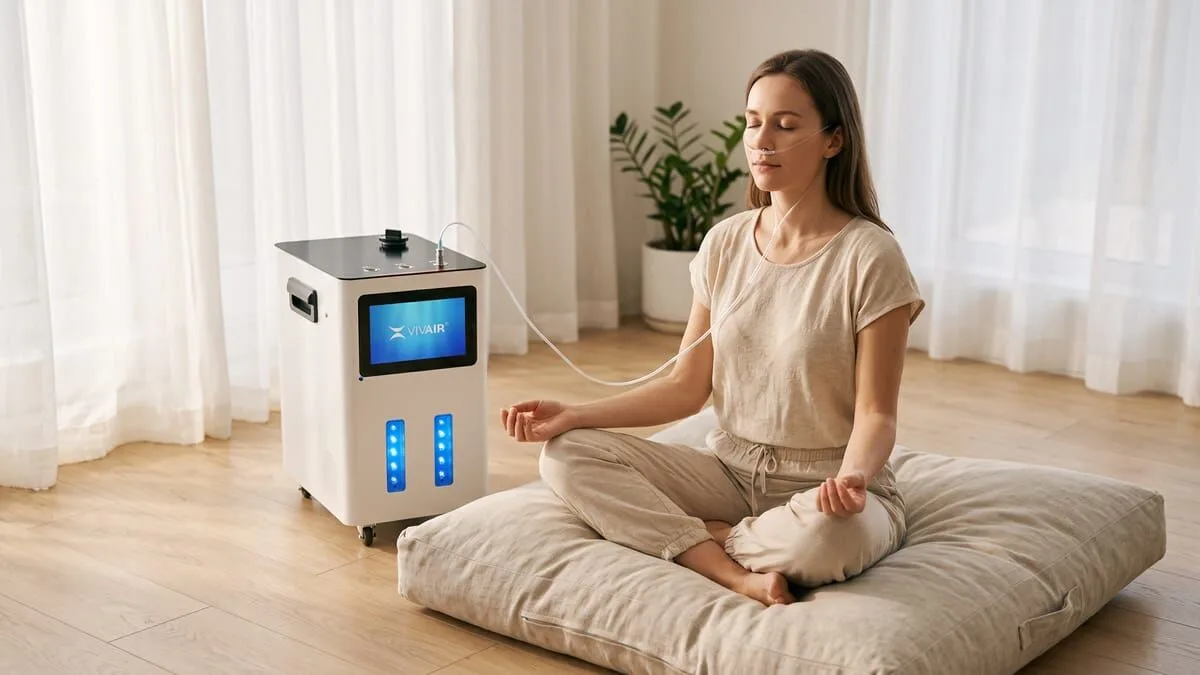
If you already have a VIVAIR Pro, your session is a good moment to practise: a stretch of time when you are sitting or lying down, in no hurry. With the nasal cannula on, choose techniques without breath holds, such as diaphragmatic, coherent or mindful breathing, and always breathe in through your nose.
VIVAIR Pro also has its own oxygen outlet, at 600 ml/min, which you can use while you meditate. VIVAIR’s oxygen does not replace medical oxygen.
Bear in mind that the studies in this guide looked at breathing exercises, not at hydrogen or oxygen. For ideas on creating your own moment of pause, read Your calm ritual, and if you are interested in breathing as a self-care habit, Biohacking and longevity.
What research in healthy adults says
- A systematic review of 15 studies concluded that slow breathing, below 10 breaths per minute, is associated with greater feelings of relaxation, comfort and alertness, and with lower arousal (Zaccaro et al., 2018).
- In 40 healthy adults, 8 weeks of diaphragmatic breathing training were associated with better sustained attention and less negative affect in tests, compared with a group that did not practise (Ma et al., 2017).
- In a trial with more than a hundred healthy adults, five minutes a day of breathing exercises for a month were associated with improved mood. Cyclic sighing was the technique with the best results (Balban et al., 2023).
- A review of the physiology of slow breathing in healthy people describes the changes that take place in the body when breathing at about 6 breaths per minute (Russo et al., 2017).
These are small to medium-sized studies, and not every result repeats in the same way for everyone. What is clear is that slow breathing is simple, free and easy to fit into your day.
Frequently asked questions
How often should I do breathing exercises?
Once or twice a day, for 2 to 10 minutes, is enough to start. A little every day is better than a lot every now and then.
Which breathing exercise is best before bed?
4-7-8 and diaphragmatic breathing are the most popular at night, because they lengthen the exhale and slow your pace. Do them in bed, with the lights off.
Should I breathe through my nose or my mouth?
Breathe in through your nose whenever you can. Breathing out depends on the technique: in 4-7-8 and cyclic sighing you let the air out through your mouth.
Do I need an app?
No. Counting is enough. A timer or an app with sound helps with coherent breathing, so you don’t have to count.
Want to make breathing your daily ritual? Discover VIVAIR Pro.
References
- Zaccaro A, Piarulli A, Laurino M, et al. How Breath-Control Can Change Your Life: A Systematic Review on Psycho-Physiological Correlates of Slow Breathing. Frontiers in Human Neuroscience. 2018;12:353. doi:10.3389/fnhum.2018.00353
- Ma X, Yue ZQ, Gong ZQ, et al. The Effect of Diaphragmatic Breathing on Attention, Negative Affect and Stress in Healthy Adults. Frontiers in Psychology. 2017;8:874. doi:10.3389/fpsyg.2017.00874
- Balban MY, Neri E, Kogon MM, et al. Brief structured respiration practices enhance mood and reduce physiological arousal. Cell Reports Medicine. 2023;4(1):100895. doi:10.1016/j.xcrm.2022.100895
- Russo MA, Santarelli DM, O’Rourke D. The physiological effects of slow breathing in the healthy human. Breathe. 2017;13(4):298–309. doi:10.1183/20734735.009817
VIVAIR is a wellbeing device, not a medical device. It is not intended to diagnose, treat, cure or prevent any disease. This article is for information only and does not replace the advice of a healthcare professional.