Hydrogen 101
Biohacking: what it is, examples and where hydrogen fits
Sleep, movement, food, light, breathing… Where does molecular hydrogen fit in a biohacking and longevity routine? What we know and what we don’t.

“Biohacking” sounds like a lab, but at heart it is a simple idea: understand how your body works and adjust your habits to feel better. And “longevity”, rather than living many years, means living them with energy, independence and enthusiasm.
In that world, molecular hydrogen comes up more and more. Let’s see where it fits, with our feet on the ground.
Biohacking is the set of habits and tools a healthy person uses to observe and fine-tune their routine (sleep, light, movement, food and breathing) so they feel better day to day. It isn’t medicine: it’s self-care with a method, testing and tracking what works for you.
First, the basics: the five pillars
No device replaces the essentials. Any wellbeing and longevity routine rests on five pillars:
- Sleeping well, at regular times.
- Moving every day, with strength, aerobic exercise and mobility.
- Eating real food, with vegetables, fibre and enough protein.
- Natural light in the morning and fewer screens at night.
- Managing stress, with breathing, meditation, nature and relationships.
Tools such as a sleep tracker, a cold shower, a sauna or a hydrogen session add value when the pillars are in place; they never replace them.
Why hydrogen interests the biohacking world
Biohackers like tools with a plausible scientific basis that are safe and easy to fit into everyday life. Molecular hydrogen (H₂) ticks several of those boxes:
- It is the smallest molecule and easily reaches the inside of cells.
- Research describes it as a selective antioxidant: in the lab it reacts with the hydroxyl radical and turns it into water.
- It leaves no residue.
- Its safety has been studied in healthy adults, even with prolonged inhalation (Cole et al., 2021).
What has been studied in healthy people
Much of the research in healthy people has focused on sport:
- Breathing a mixture of hydrogen and oxygen before intense effort was associated with less perceived tiredness and effort in 24 active men (Dong et al., 2024), and with less perceived effort in another incremental test (Hong et al., 2022).
- During recovery after exercise, jump height fell less after breathing hydrogen, although the other tests showed no differences (Shibayama et al., 2020).
- Seven days of short sessions were associated with a slightly higher top running speed, a result the authors describe as preliminary (Javorac et al., 2019).
These are small studies with devices other than VIVAIR. Interesting, but not conclusive. A good biohacker knows that and tries things on themselves with common sense.
How to fit it into your routine
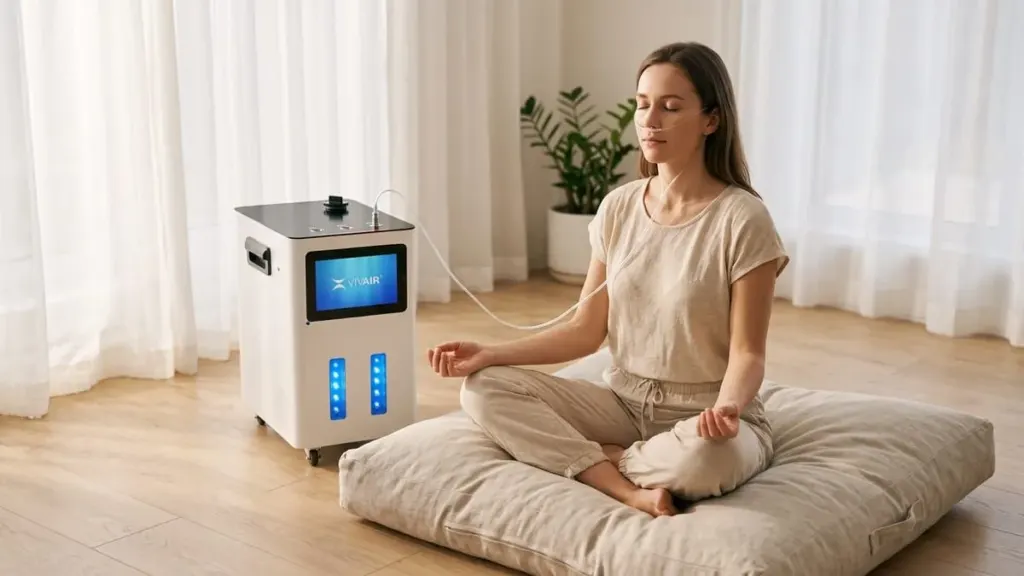
- Pair it with a habit you already have: evening reading, morning meditation or stretching after training.
- Consistency over intensity: several sessions a week at a fixed time are usually easier to keep up than a long session now and then.
- Listen to your body and note how you feel. That is the essence of biohacking.
- Share the session: with two independent outlets, your partner can join you.
Longevity as a lifestyle
Longevity is not bought in a device: it is built every day through habits. What a well-chosen tool can do is help you keep those habits, giving you a fixed moment to stop, breathe and look after yourself.
That is the role we want VIVAIR to have in your home: not a promise, but a ritual you look forward to repeating.
Want to add it to your routine? Discover VIVAIR Pro or read what science says.
References
- Cole AR, Sperotto F, DiNardo JA, et al. Safety of Prolonged Inhalation of Hydrogen Gas in Air in Healthy Adults. Critical Care Explorations. 2021;3(10):e543. doi:10.1097/CCE.0000000000000543
- Dong G, Wu J, Hong Y, et al. Inhalation of Hydrogen-rich Gas before Acute Exercise Alleviates Exercise Fatigue: A Randomized Crossover Study. International Journal of Sports Medicine. 2024;45(13):1014–1022. doi:10.1055/a-2318-1880
- Hong Y, Dong G, Li Q, et al. Effects of pre-exercise H2 inhalation on physical fatigue and related prefrontal cortex activation during and after high-intensity exercise. Frontiers in Physiology. 2022. doi:10.3389/fphys.2022.988028
- Shibayama Y, Dobashi S, Arisawa T, et al. Impact of hydrogen-rich gas mixture inhalation through nasal cannula during post-exercise recovery period. Medical Gas Research. 2020;10(4):155–162. doi:10.4103/2045-9912.304222
- Javorac D, Stajer V, Ratgeber L, et al. Short-term H2 inhalation improves running performance and torso strength in healthy adults. Biology of Sport. 2019;36(4):333–339. doi:10.5114/biolsport.2019.88756
VIVAIR is a wellbeing device, not a medical device. It is not intended to diagnose, treat, cure or prevent any disease. This article is for information only and does not replace the advice of a healthcare professional.