
Hydrogen 101
What is molecular hydrogen and why does science care?
Molecular hydrogen (H₂) is the smallest molecule there is. We explain what it is, why science studies it and what studies in healthy people say.
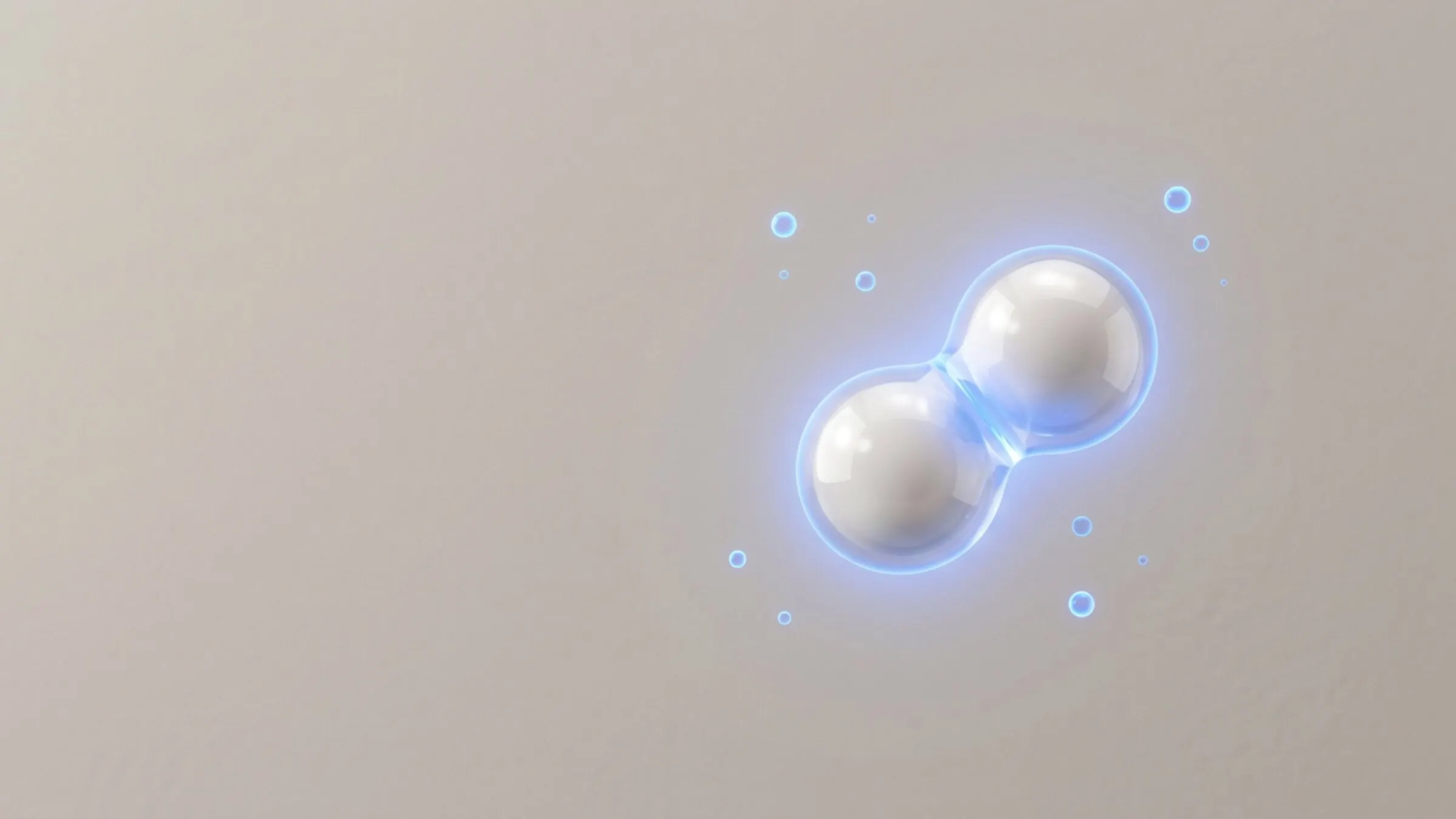
A few years ago, hardly anyone talked about hydrogen outside chemistry labs or the car industry. Today it comes up in conversations about wellbeing, sport and longevity. What is so special about such a simple molecule? Let’s start at the beginning.
The smallest molecule in the universe
Hydrogen is the lightest and most abundant element in the universe. When two hydrogen atoms join, they form molecular hydrogen, written H₂. It is a colourless, odourless and tasteless gas, and it is the smallest molecule that exists.
That size is precisely what sparks scientific interest: H₂ diffuses very easily, crosses membranes and can reach the inside of cells, including structures such as the mitochondria and the nucleus.
Fun fact: your own gut already produces hydrogen. Some bacteria in your gut flora make it when they ferment the fibre in food. H₂ is nothing foreign to your body.
Why science studies it
Our body naturally produces reactive molecules, often called “free radicals”, as part of its daily functioning. Most of them serve useful purposes, and the body has its own systems to keep them in balance.
For almost two decades, research has described molecular hydrogen as a selective antioxidant: in laboratory studies it reacts mainly with one of the most reactive species, the hydroxyl radical (•OH), and turns it into water. Unlike other antioxidants, it does not appear to interfere with the reactive molecules the body needs in order to function.
Another line of research looks at how H₂ might act as a signal for the body itself, for example through the Nrf2 pathway, a mechanism cells use to switch on their natural antioxidant defences.
And there is one detail that makes it particularly interesting: it leaves no residue. What is not used is breathed out, and what reacts becomes water.
What studies in healthy people say
Research in people is still young and most studies are small, so they should be read with caution. Here are some carried out with healthy people or healthy athletes, published in peer-reviewed scientific journals:
- Safety. In a phase I study, 8 healthy adults breathed air containing 2.4 % hydrogen for 24, 48 and 72 hours in a row, under supervision. The researchers observed no clinically relevant changes in the parameters assessed (Cole et al., 2021).
- Sport. In 24 healthy, active men, breathing a mixture of hydrogen and oxygen for 60 minutes before intense exercise was associated with less perceived tiredness and effort (Dong et al., 2024).
- Rest. In 20 healthy young women, 60 minutes of inhalation at rest were associated with changes in the respiratory quotient and ventilation (Grepl et al., 2025).
None of these studies was carried out with VIVAIR: they are third-party studies, with other devices and other conditions, and they do not show that any particular device produces those effects. You will find the full catalogue, with a neutral summary of each one, on our Science page.
And how do you take hydrogen?
There are two common ways:
- Drinking it, dissolved in water (hydrogen water).
- Breathing it, with a generator that produces it on the spot from purified water by electrolysis.
The second lets you receive much more hydrogen in less time while you do something else: read, meditate, work or rest. That is what VIVAIR Pro does: it generates 1,200 ml/min of hydrogen and, through a separate outlet, 600 ml/min of oxygen, for one or two people at a time.
In short
- Molecular hydrogen (H₂) is the smallest molecule that exists and easily reaches the inside of cells.
- Research describes it as a selective antioxidant and studies its role in the Nrf2 pathway.
- It leaves no residue: what reacts becomes water.
- Studies in healthy people are promising, but still small: science keeps moving.
Want to know what your hydrogen routine at home could look like? Discover VIVAIR Pro or get in touch with our team.
References
- Cole AR, Sperotto F, DiNardo JA, et al. Safety of Prolonged Inhalation of Hydrogen Gas in Air in Healthy Adults. Critical Care Explorations. 2021;3(10):e543. doi:10.1097/CCE.0000000000000543
- Dong G, Wu J, Hong Y, et al. Inhalation of Hydrogen-rich Gas before Acute Exercise Alleviates Exercise Fatigue: A Randomized Crossover Study. International Journal of Sports Medicine. 2024;45(13):1014–1022. doi:10.1055/a-2318-1880
- Grepl P, Botek M, Krejčí J, McKune A. Molecular hydrogen inhalation modulates resting metabolism in healthy females. Medical Gas Research. 2025. doi:10.4103/mgr.medgasres-d-24-00085
VIVAIR is a wellbeing device, not a medical device. It is not intended to diagnose, treat, cure or prevent any disease. This article is for information only and does not replace the advice of a healthcare professional.